
The real reason your eyes water on every ride — and why sunglasses were never going to fix it
Riders have been squinting through it for decades, blaming the wind, their age, their glasses. Turns out we've been handed the wrong tools the entire time.

By Josh A.
You know the moment.
You're forty minutes in. Good road, good weather. And your eyes are streaming so badly you're riding half-blind, blinking hard, tipping your head to one side to get out of the blast.
You wipe them at the light. Two minutes later it's back.
So you do what every rider does. You buy sunglasses. Then wraparounds. Then goggles that dig into your cheekbones and fog the second you stop moving. Maybe a bandana that slips down your nose every ten miles.
And none of it really works. So eventually you shrug and decide this is just part of riding.
It isn't.
The thing nobody tells you about wind
Here's what's actually happening to your face at speed, and it's simpler than you'd think.
Air doesn't need a big opening to get to your eyes. It needs any opening. At 60mph, air isn't a breeze — it's a pressurised jet looking for a gap. And it will find every single one you leave it.
Sunglasses don't have a sealing problem. They have a gap problem — and every gap is a front door.
Where the air gets in
See the pattern?
Every single one of those was built for something else. Sunglasses are beach gear. Goggles are ski gear. A bandana is a piece of cloth. They got repurposed for riding because nothing better existed at a price a normal rider would pay.
You weren't doing it wrong. You were handed the wrong tools and told to make them work.
So why does everything fog?
This is the part that makes riders give up on face gear entirely — and the explanation is something you already understand from your own house.
Think about a single-pane window in winter. Cold outside, warm inside, and the glass streams with condensation.
Now think about a double-glazed window. Same cold outside, same warm inside. Bone dry.
The difference isn't the glass. It's the pocket of air trapped between the two panes. That air keeps the inner surface warm — and fog can't form on a warm surface. It's not a coating. It's not a spray you reapply every week. It's just physics.
Every fogging problem you've ever had is a single-pane problem.
Your breath is warm. Your lens is cold. Put those two together with nothing in between and you get condensation — every time, guaranteed, no matter what you spray on it.
Trap air between two lenses instead, and the inner surface never goes cold enough to fog. That's it. That's the whole trick.
Which raises the obvious question: if we've known this since the 1930s, why is nobody building riding gear that way?
Mostly because it costs more. It's cheaper to print "anti-fog" on a single lens, sell it for $15, and let you find out on the road.
What actually solves it
Once you understand the problem is sealing, not shading, the answer stops being complicated.
You need something that covers the whole face — not a strip across the eyes. You need it to seal without clamping. And you need a double lens so your breath never meets a cold surface.
Cover the face. Seal the gaps. Double the lens. That's the entire solution.
That's what the Skull™ is.
A full-face shell with a double lens — for riders who won't wear a full-face helmet
It's not sunglasses with delusions of grandeur, and it's not a helmet. It's a hard shell that covers your whole face, seals the gaps air uses, and puts a double lens in front of your eyes so fog never gets a foothold.
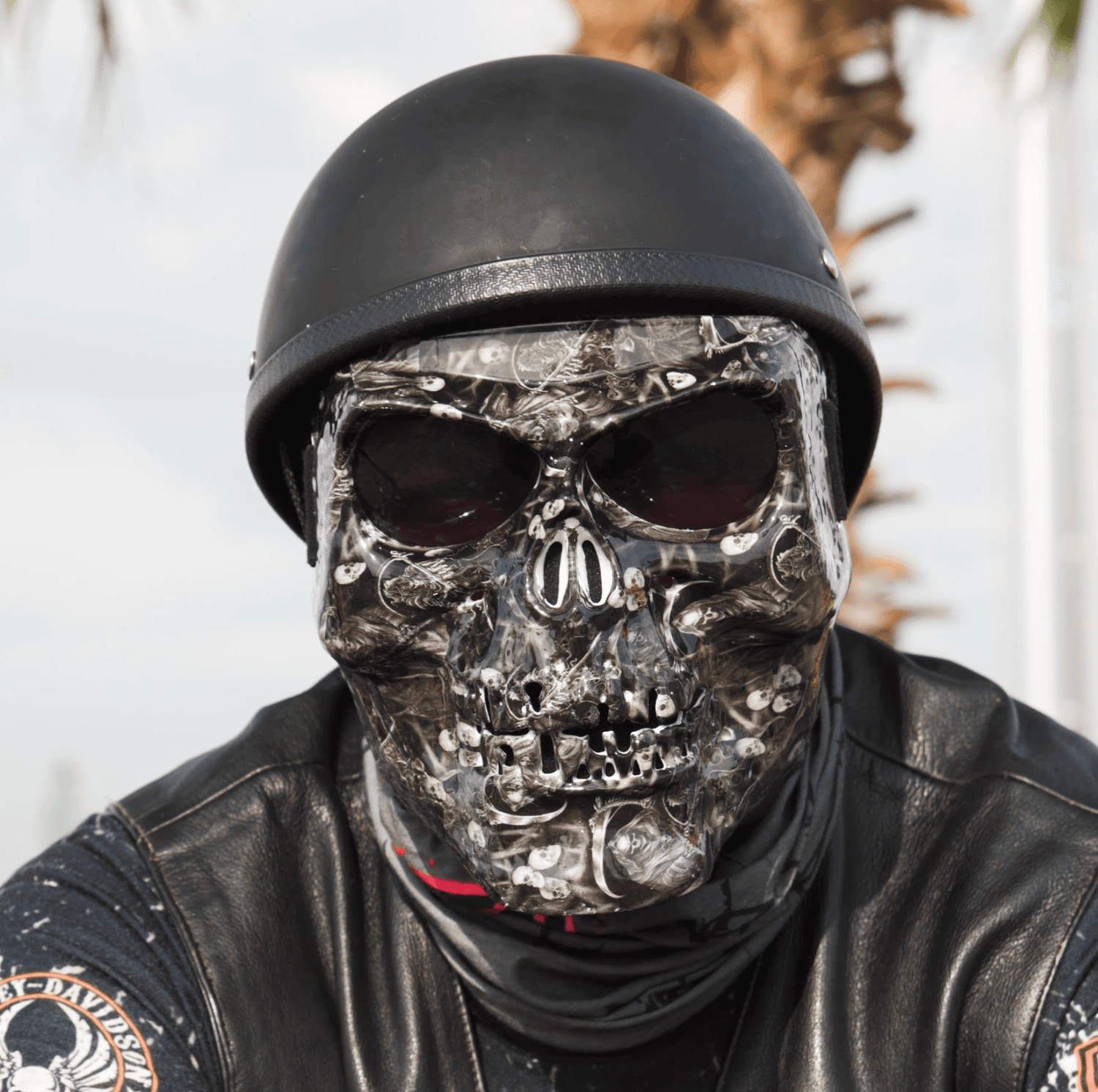
Real riders, real reviews
-
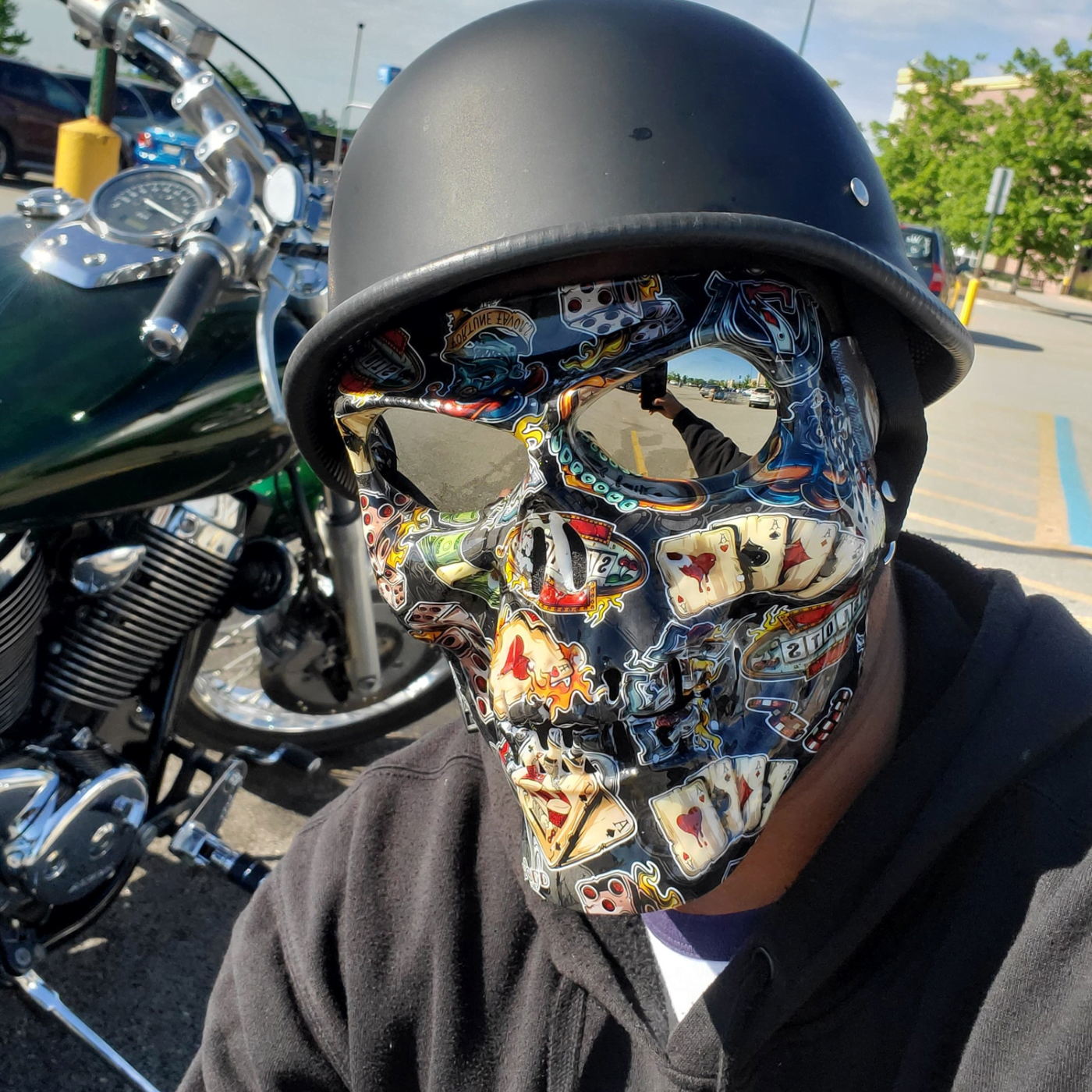
Great product at a good price
Had my first ride with my new mask this morning. The mask barely fogged up at all and visibility is just like wearing a pair of sunglasses. All in all I highly recommend!
-

100% Awesome
Fantastic quality, very well made and very comfortable.
Super fast shipping to US.
I highly recommend 👌I will scare 😱 the crap out of people on my quad 😉 -
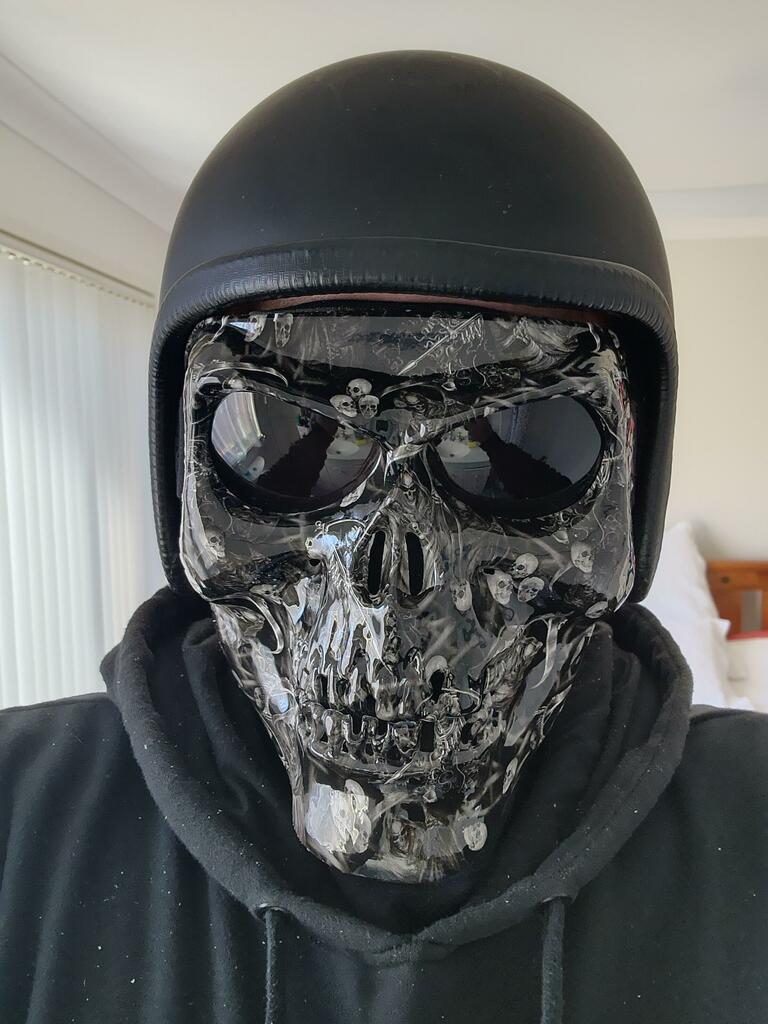
Love this!!
I love to show to my fellow riders how this mask are the best for riding!!!

"Alright, but it's a $47 mask off the internet"
Fair. Let's deal with that head-on, because plenty of riders had exactly that thought before they ordered.
Daniel Tremblay's review starts with the skepticism out loud — "Liked the look but questioned the quality before ordering but decided to order" — and ends with "thoroughly impressed with quality and fit." Luis Rodriguez was worried it wouldn't fit his face: "I was a bit skeptical on ordering it at 1st because of my wide cheeks.. but it fit like a glove."
Here's the honest comparison — not against a $15 pair of shades, but against what you've already spent:
Add up the sunglasses in your drawer right now. It's more than $47.
Where this leaves you
Next ride, one of two things happens.
Either you're squinting into the blast again at mile forty, wiping your eyes at every light, riding half-blind through the good part of the road — the same as every ride before it.
Or you're looking straight ahead. Clear. Sealed. And somebody at the lights is staring.
